CNC Machining
CNC Turning Services for Shafts, Bushings & Fittings — Lathe Factory Direct
Round parts turned in Shenzhen to ±0.01 mm: shafts, pins, bushings, standoffs and threaded fittings in brass, stainless, titanium and aluminum. Bar-fed for volume, chuck for one-offs.
CNC turning makes the round parts. MOMAKING's lathe cells produce shafts, pins, bushings, spacers, fittings, nozzles, collars, standoffs and turned hardware with milled flats — bar-fed for swarms of small parts, chuck-loaded for larger diameters up to φ150 mm. Where a part needs side features, live tooling and our turn-mill cells complete it in one setup instead of handing off to a mill.
Parts We Turn Every Week
The rotated-geometry pool we machine daily includes stainless 304/316 shafts with ground bearing journals, brass C360 pneumatic fittings with sealed port faces, aluminum standoffs and spacers in thousands, titanium orthopedic prototypes, and mild-steel hydraulic adapters. Threads — metric, UNF/UNC, NPT, BSP — are cut and gauged, not rolled.
Typical turned tolerances sit at ±0.01 mm on diameters and true position, with Ra0.4–Ra0.8 finishes on journals. Combined turn-mill parts keep cross-hole patterns concentric because datums never leave the spindle.
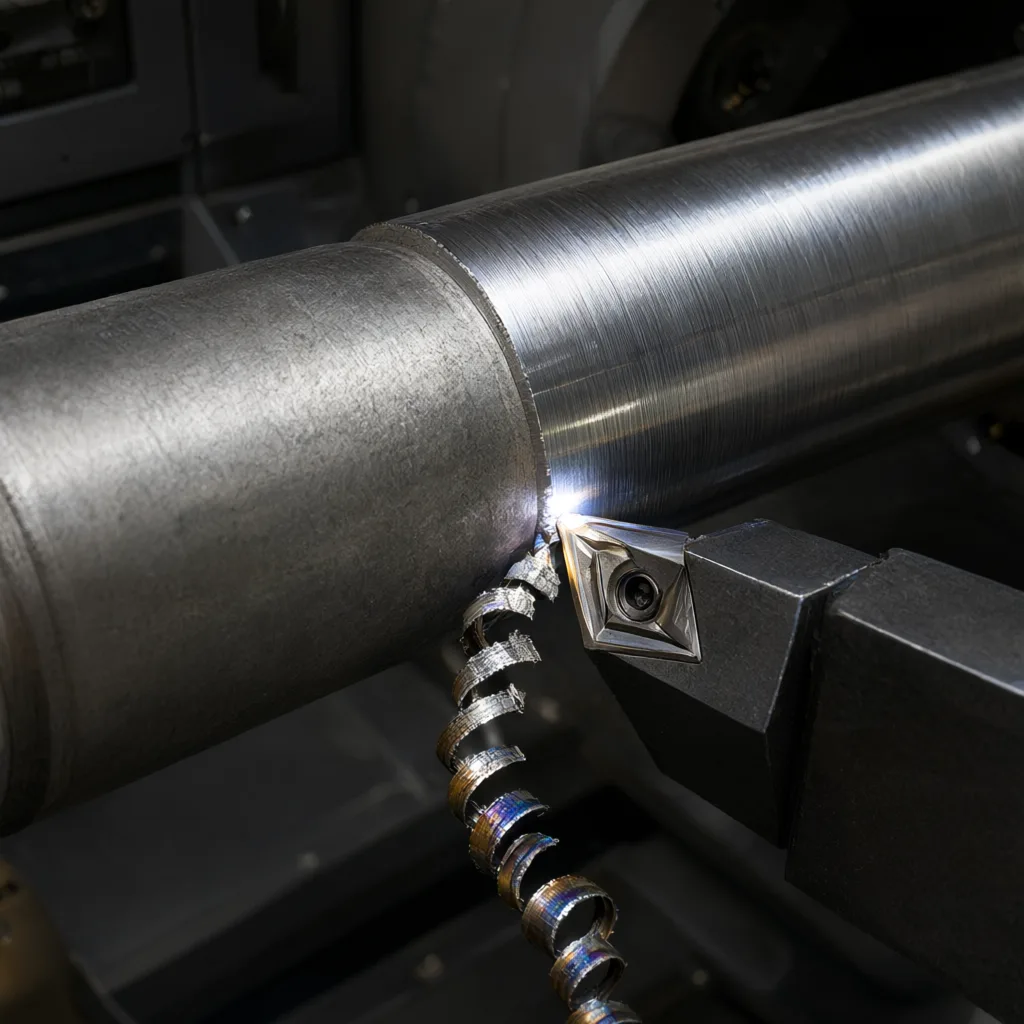
FIG. 01 — A stainless shaft between centers: spiral chip control is half the surface-finish battle.
Materials and Bar Stock
We keep aluminum 6061/7075, brass 360, stainless 303/304/316, mild steel 12L14/1045, titanium Gr2/Gr5 and free-machining plastics POM/Delrin, nylon and PEEK in bar. Long turning up to 300 mm between centers is routine; slender shafts get steady-rest support to kill chatter.
Lead Time and Batch Economics
A first-off sample shaft can ship in 2 working days. Turning is where volume discounts bite hardest: bar-fed cells amortize setup across hundreds of parts per spindle-hour, so 1,000 brass fittings can cost far less per piece than 10. The AI quote shows that curve (1 / 100 / 1,000 pcs) before you commit.
Finishing follows the same menu as milling: anodize for aluminum, passivation for stainless, nickel and zinc plating for steel and brass, plus heat treat and deburr levels specified on the drawing.
Quality on Round Parts
Every turned batch is checked with micrometers, bore gauges and thread gauges; critical journals get CMM roundness runs. First-article dimensions are recorded before the run continues; in-process spot checks follow the control plan your drawing implies — or the one our engineer proposes at DFM.
Send the STEP plus a turned drawing with GD&T callouts if you have them; if you do not, say what the part does — our engineers mark the features that genuinely need ±0.01 mm and let the rest ride at standard, which is how you buy tolerance only where it earns its keep.
Frequently Asked Questions
What diameters and lengths can you turn?
Can you cut threads?
Do you do swiss-style high volume?
Is turn-mill or mill-then-turn cheaper?
Bar Feeder or Chuck: How Round Parts Get Queued
Small-to-medium turned parts in bar stock run the bar-fed lane: the spindle picks fresh stock automatically, part after part, a complete part every tens of seconds once proven. That is the lane where your 1,000 brass fittings price out dramatically under your 20 prototypes — setup is one amortized mountain, cycle time is seconds per part. Larger diameters or long parts move to chuck-loaded cells: manual load, more setup per part, no problem at all for the 5–50 piece band that a bar feeder would configure for twenty minutes to save ninety seconds.
The second decision is single-spindle vs sub-spindle (or two turret) work: a shaft needing both ends fully machined — centres, journals, flats, cross-holes — transfers the part spindle-to-spindle mid-cycle and finishes in one clamping history. Both-ends work on a single spindle means a second setup, second indicating, second concentricity tax on every batch. If your drawing has datums on both ends, ask for the sub-spindle quote explicitly; the delta is small and the accuracy dividend is permanent.
Thread Classes and Gauging: What to Specify
A “1/4-20 threaded” callout asks nothing and gets whatever the tapping head gave. Specify class: 2A/2B is the general-assembly default — hand-tight with wrench preload, gauge-checked go/no-go on batches; 3A/3B buys tighter pitch and flank control for index mechanisms and optical barrels, at measurable cost in slower tapping and 100% gauging. For polymer parts, specify insert threads (heat-set or ultrasonic brass) instead of thermally-forming nylon threads that relax with temperature cycles. And note the boring universal truth: rolled threads (where geometry allows a roll instead of a cut) are stronger, faster and slightly larger — adjust the minor diameter accordingly or the nut will sing a sad song.
Gauging on every production batch: GO/NO-GO ring and plug gauges by class, thread-form visual comparison for single-start cosmetic threads, and CMM true position when the thread is on a datum axis. The gauge serial numbers go on the report — that is what makes a claim repeatable in an audit.
The Turned-Part Buyer's Checklist
- State the mating part. A shaft into a $2 printed bushing and a shaft into a $400 ground bore deserve different tolerances and different finishes; the sentence changes the price.
- Call out the chamfers. Missing chamfer specs mean assembled parts that won't start by 0.2 mm; a 1×45° note on the drawing protects your Wednesday afternoon.
- Watch slenderness ratios. Length-to-diameter beyond ~12:1 needs steady rests, slower cuts, or design stiffening — and will quote accordingly. A φ6×180 mm shaft is legal; it is also a budget line.
- Decide knurling/serrations early. They mark nearby diameters; plan which land is allowed to wear the witness.
A Second Look at Bar-Fed Economics
The arithmetic that surprises first-time turned-part buyers: a bar-fed cell's hourly rate is high, but its per-part floor is set by cycle seconds — a 32-second brass fitting with a 2-second part-transfer produces 90+ pieces an hour once proven. Setup (cams or live-tool program, bar size, collet, gauge-check) is two to six hours spread across the run. At 20 pieces, setup dominates and you pay machining-shop prices; at 2,000, setup is pennies per piece and the cell out-machines every chuck-loaded shop. That curve is why sending a realistic annual quantity — even a bracketed estimate — is worth more on a turned part than on any other process here: it decides which lane the engineer queues you into, and the lane difference is the price difference.
Worked Example: The Steel Shaft That Quoted Three Ways
A φ25 × 140 mm 304 shaft with two ground journals, a M16 thread, one cross-hole and a 3 mm keyway arrived as a 500-piece RFQ. Lane one — chuck-loaded lathe, second-setup mill for the keyway and cross-hole: the honest-but-slow baseline at $11.80 a piece. Lane two — bar-fed with live tooling: the keyway milled and the cross-hole drilled without the part ever leaving the spindle, setup amortized across the run: $4.90. Lane three — the DFM suggestion: the keyway's duty was a shear pin the assembly never actually loads (their own engineer confirmed), and the cross-hole existed to break a thread tap. Deleting both ghost features returned $3.60 in lane two, and the customer's drawings changed once, forever, for every future part number in that family. The AI quote priced lane two geometry instantly; the engineer's review found lane three, and the quote printed both so the buyer could take the argument to their own design team with numbers instead of opinion.
The lesson generalizes: turned parts carry two hidden invoices — the lane (setup amortization) and the features (who actually needs them). A quote that itemizes only the first is a machine-shop quote; a quote that sees the second is an engineering quote. Ask every turned-part RFQ which features the shop would delete for a dollar figure, and the answer either arrives with a number or tells you exactly who is reading your drawing.
Get this part priced
Upload your STEP file - AI quote in seconds, engineer-verified quote within 24 hours.