3D Printing
SLS Nylon 3D Printing Services — Functional PA12 Parts, No Supports
Living hinges, snap fits, ducts and jigs that flex, heat and clip like molded plastic — isotropic, support-free and batch-priced from a Shenzhen SLS line.
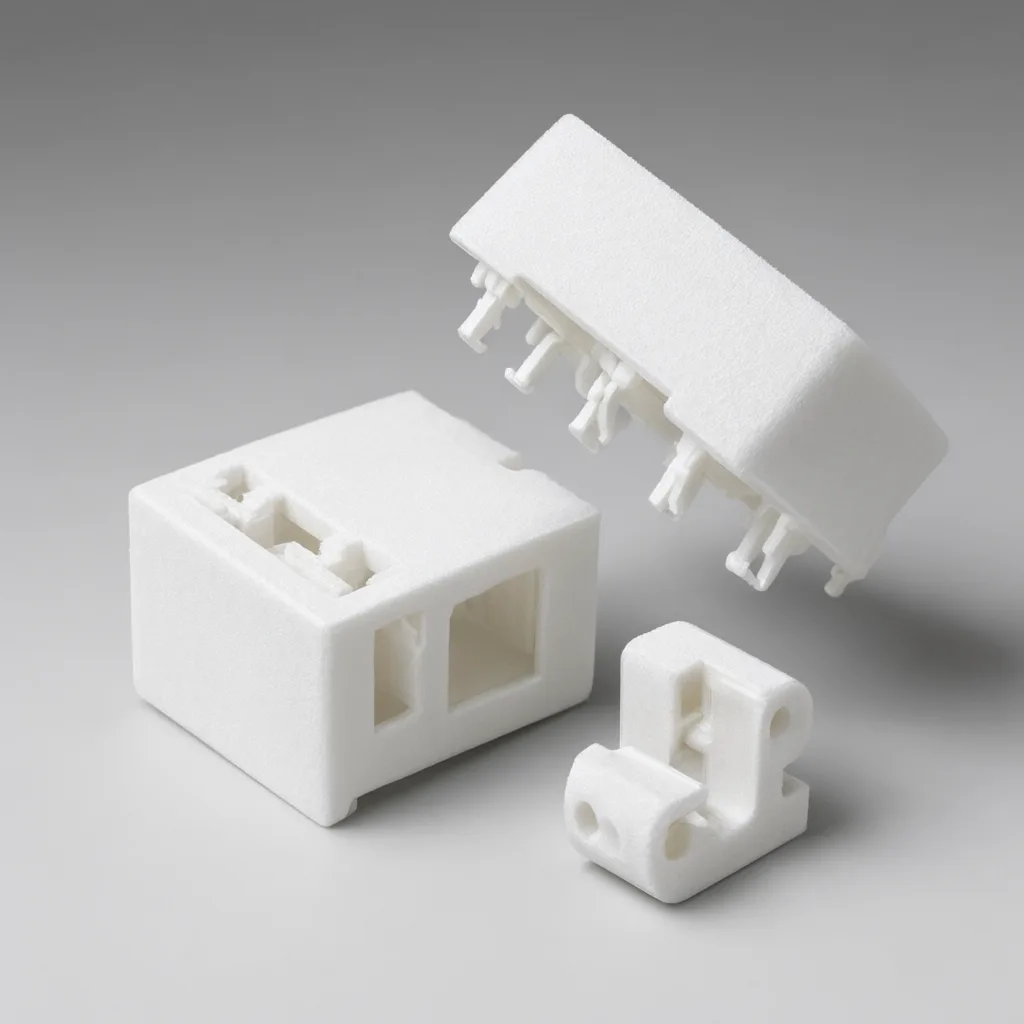
SLS nylon prints the parts that have to work. A laser sinters PA12 powder into dense, self-supporting geometry — no support structures to break off, no layer-plane weakness dictating orientation, parts pulled from a warm powder cake in production batches. Living hinges, snap fits, ducts, grilles, jigs and drop-tested prototypes are what this process was made for.
Why Engineers Pick SLS for Functional Parts
- Isotropic strength: sintered nylon behaves close to molded plastic in all directions — assemblies flex, clip and survive drops without delaminating along layers.
- No supports: enclosed channels, lattice grips and interlocking assemblies print inside each other; overhangs up to full inversion are free.
- Batch economics: a build volume filled with two hundred identical clips prices per part in cents, not dollars — SLS quietly runs end-use production for consumer and industrial brands.
- Heat and chemicals: PA12 runs to roughly 80–100 °C continuous and shrugs off fuels, solvents and oils that melt resin.
What Ships Out of This Line
Weekly work includes automotive intake doodle prototypes and ducting, appliance clips and internal brackets, drone frames that survive crash testing, medical device housings for fit trials, and custom jigs that hold tolerance callouts on assembly benches. Surface as-printed is matte and slightly powdery — dyeing (black, grey, white, custom colors), bead blasting, vapor smoothing and sealing against fluid absorption are standard add-ons.
Accuracy and Design Rules
Typical accuracy is ±0.1–0.2 mm on functional dimensions with 0.3–0.5 mm clearance recommended for sliding fits; minimum wall is 0.8–1.0 mm and holes below 1 mm should be printed rather than cored thin. Powder is recovered between builds; parts leave calibrated, dried and lot-tracked. Where a seat or bore must be exact, CNC finishing happens on the bench next door in the same order.
Lead Time and Cost Logic
Standard lead: 24–48 hours from confirmed quote for parts inside the build envelope; large nested batches add scheduling, not mystery. Pricing follows packed build volume — orientation matters far less than resin, but wall thinning and hollowing still move the number. The AI quote prices your quantity curve (1/100/1,000) instantly; production programs typically lock per-part pricing with SLS once volumes stabilize in the thousands.
Files and Process
Send STL or STEP; assemblies can arrive as multi-body files and print nested together, staying assembled as printed for true mating checks. Every order passes a powder-recovery, drying and dimensional checklist; reports ship with batches. Choose nylon when the part must flex, heat, clip or survive a toolbox; choose resin when it must shine. Unsure? Two sentences about the duty cycle and our engineers pick for you — [email protected] or WhatsApp +1 315-623-3808.
Frequently Asked Questions
Is SLS stronger than resin?
What colors can nylon be dyed?
Can you print assembled mechanisms?
How many pieces per batch is SLS worth?
PA12 vs PA11 vs Glass-Filled: Choosing the Powder, Not Just the Process
“SLS nylon” hides a family. PA12 is the general-purpose workhorse: balanced stiffness, ~90 °C heat deflection, low moisture pickup during service, and the best surface of the nylons. PA11 (castor-derived) flexes where PA12 snaps — living hinges, clip geometry, impact bumpers — at slightly lower stiffness. Glass-bead-filled PA buys flatness and creep resistance: thin plates stay plate-shaped at 80 °C, snap bosses stop cold-flowing under screw torque. TPU elastomers run in the same machine class and print gaskets, feet and flexible couplings that rebound. The RFQ line that gets the right answer is a duty sentence: what does the part touch, how hot, how often, what should never crack. The powder selection then reads as arithmetic, and the quote prices the family correctly instead of defaulting to the cheapest pallet.
Powder economics deserve a plain sentence: SLS runs 50–70% fresh powder blended with recovered sieve powder; reuse is standard and honest, and a well-run sieve line means your parts get the same lot behavior across batches. Regulated programs can require fresh-powder-only builds; that's a flagged line item and it changes price by design, not by surprise.
Surface, Dyeing and Sealing: From Powder-Soft to Product-Ready
As-built SLS is matte, slightly powdery and porous at the micron scale: dye (aqueous black is the commodity, custom colors for programs) opens the look, and each step down the finishing ladder is a visible product upgrade. Bead-blast evens the sheen; vapor-smoothing re-melts the surface skin to a semi-gloss and — the underrated benefit — seals the porosity so fluids stop wicking (fuel-side parts and food splash zones need this, not just cosmetics); epoxy infiltration + bead-blast gives near-injection-molded dimensional surface quality for tight-tolerance mechanisms. Dyeing shifts dimensions by single-digit microns (ignore unless you hold ±0.05 everywhere); vapor smoothing can add tenths of a percent to soft-fit clearance — we hold critical bores through the process by design. Tell us the look and the fluid, and the finishing tier comes quoted, not improvised at packing.
Designing for the Powder Bed: Four Rules With Reasons
- Keep wall ≥0.8 mm but above all keep it uniform — thick islands beside thin skins store heat unevenly and warp both.
- Put a 0.3 mm gap minimum between moving printed parts — powder needs a way out; printed-then-separated assemblies are beautiful but the cake is powder and powder finds interference fits.
- Sink fillets and drains on hollows even without supports — trapped unsintered powder is mass you didn't order, and a 2 mm hole solves it forever.
- Orient for flatness in your head before checking ours: large thin plates want to stand near-vertical in the bed; the builder will fight the warp budget with nesting angle, and if you allow it to do so the plate stays flat.
Production Batch Math: The 240-Clip Build That Priced Out
A bracket with numbers explains the SLS batch lane: a 45 mm snap clip prints 240-deep in one PA12 build, the machine's 230 mm-tall cylinder fitting eight nesting layers; the build runs overnight and depowders the next morning. At batch pricing that lands the clip in the low single-digit cents per piece — against injection molding at a $3,000 tool plus $0.004/pc, which beats printing somewhere near 40,000 clips. For a specialty instrument selling 2,500 units a year, the printing column wins the entire product life and the tool never exists; that is the band where most specialty hardware actually lives, and why SLS quietly ships end-use clips, knobs, grilles and impellers instead of just prototypes.
The batch file preparation that protects this economy: parts arrive as one multi-body STEP or a folder of labeled STLs and we print your assembly's parts as a family — same powder lot, same oven, same cooling curve — so mating clips and housings shrink identically and assemble identically across the batch. Dimensional spot plans (first/mid/last per layer, CMM on your named features) ride on the shipment; the lot card ties every part to the drum. Nothing about batch printing is hobby-grade; the paperwork volume simply scales with the order like any production process.
Get this part priced
Upload your STEP file - AI quote in seconds, engineer-verified quote within 24 hours.