Sheet Metal
Laser Cutting Services — Fiber Laser to 20 mm, Nested & Deburred
Pilot holes, grilles and flat patterns cut to ±0.05–0.1 mm with nesting that watches your material bill — then straight into bending, hardware and coating on the same PO.
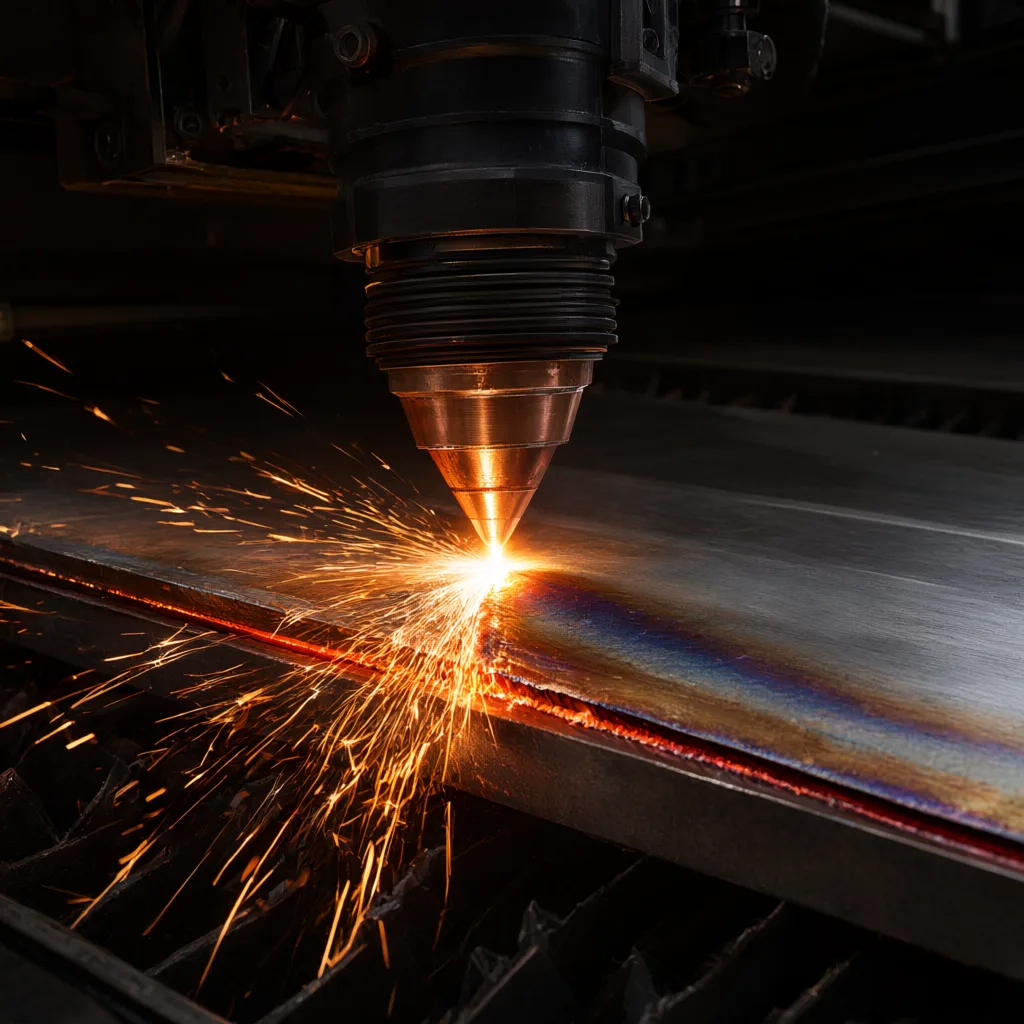
Fiber laser cutting is the front door of every sheet metal job. A focused fiber laser traces your profile through mild steel up to 20 mm, stainless to 12, aluminum to 15 and brass/copper to 8 — kerf-controlled edges, ±0.05–0.1 mm positional accuracy, pilot holes, tabs and micro-joints straight from the DXF. One-offs to nested production sheets run on the same bed with the same nesting optimizer watching your material bill.
What Arrives as a DXF (or Should)
- Flat parts: gussets, flanges, cover plates, nameplate panels, stencils and shim packs — cut-only work that quotes and ships in 1–3 days.
- Enclosure blanks: the flat pattern feeding the brake line; our DDM drawings (free) are made to be cut here, bend-relief included.
- Nested production: hundreds of parts across one sheet with skeletonized outlines for rigid, flat parts — nesting strategy is half the price of thin parts and it is optimized for every order, not just big ones.
- Decorative & functional patterns: ventilation grilles, speaker mesh, architectural screens; feature size floors stated up front so intent survives the kerf.
Material and Thickness Matrix
| Material | Max thickness | Comfortable band | Edge note |
|---|---|---|---|
| Mild steel (SPCC/Q235) | 20 mm | 0.5-12 mm | Cut-ready black or oiled; paint/primer base |
| Stainless 304/316 | 12 mm | 0.5-8 mm | Clean oxide on bright cuts; passivation optional |
| Aluminum 5052/6061 | 15 mm | 0.5-8 mm | Reflective alloys need assist-gas tuning; anodize-ready |
| Brass / copper | 8 mm | 0.3-4 mm | High reflectivity - slower, thicker limits tighter |
Design Rules That Save You Money
Minimum feature and hole size scales with thickness (rule of thumb: hole diameter ≥ sheet thickness; slot width ≥ kerf + radii), inside corners need the tool radius, and tolerances tighter than ±0.1 mm on thick plate ask the physics politely instead of demanding. Every one of these appears as a marked note on the DFM, not a surprise shipment. Edge quality: dross-free standard cut, spatter-free cosmetic grade on request, and square-edge options for bearing faces — all quotable line items.
Lead Time and the Line Behind the Laser
Cut-only flat parts ship in 1–3 working days; anything continuing to brake, hardware, weld and coat follows the sheet metal lanes behind it (prototype 3 days, batches 7–15). Send DXF/DWG (1:1 scale) or a STEP we unfold for you free — material, thickness and finish stated on the RFQ and the AI engine returns the tiered price immediately. Talk to the cutting floor: [email protected] / WhatsApp +1 315-623-3808.
Frequently Asked Questions
What file do you need for laser cutting?
Can you cut and form in one order?
Why is brass limited to 8 mm?
Do you keep tolerance on thick plate?
Nesting: Where the Material Bill Is Really Decided
Fiber laser pricing is material times area plus machine time, and the nesting engineer controls both terms. Two hundred identical 60 mm brackets at 63% sheet utilization versus 78% — through better interlocking, shared edge cuts (cannibalising the kerf between adjacent parts), and choosing 2.5 mm instead of 3 mm stock because the part doesn't need the stiffness — is a 20–30% invoice swing on the same order, plus the smaller consumables. Good nesting also reads your grain and directionality: aluminum with a brushed or grain finish must all point one way; parts that must stay dead-flat want the sheet's center region, avoiding the edge strip; small parts fill the skeleton holes left between big ones, and micro-joints keep tiny parts from tipping into the cut zone and becoming missiles (they break off in deburring, one nibbling punch and three seconds of labor versus a jammed head and a shift). We optimize nesting on every job including small ones because material doesn't care about your order size, and the optimized nest arrives back to you as the cut sheet layout — you can see your material's fate and dispute it, which is about as transparent as a fab can be.
Edge Quality, Gas and Thickness: Physics With Price Tags
Assist gas is the consumable hidden in thick-plate quotes: mild steel oxidizes with oxygen (exothermic boost, dark oxidized edge needing prep before coat), stainless and aluminum blow with nitrogen (clean metallic edge, pricier gas), and thick aluminum wants high pressure and slow speed for drag-free walls. Edge quality tiers are physical, not cosmetic: standard cut allows light dross on the bottom face, knocked loose at deburr; cosmetic allows spatter-free both faces — slower pierce parameters, better focus timing, the line item your visible-panel parts want; square-edge for shear-critical bearing faces runs at reduced traverse with focus profiling and is quoted like the machining pass it essentially is. Thickness honesty: dross-free capability collapses at ~12 mm mild on most shops' daily mix; we cut to 20 and say what 16–20 actually looks like — slower, with a draft angle you should note on the weld-prep drawing. And for holes: round stays round to thickness-to-diameter 1:1; below that the lance pierces and walks, so 1 mm holes in 3 mm steel want a punch station, not a laser; feature-minimum tables in the DFM keep your parts on the correct side of each cliff.
Kerf, minimum-feature and punch-vs-laser tables arrive with every quote as a marked DXF overlay — free, and yours to keep whether or not you order.
Case Study: The Vent-Panel Order That Was Priced on Sheet Geography
An IoT gateway's top cover is a 240×180 mm grill of 1,100 slots in 1.2 mm 304, a part whose price is a pure nesting story. First quote, single-up cut with lead-ins and lead-outs per feature: 14 minutes of laser time, heavy pierce counts, $9.40 a piece. The re-quote: 18 panels per sheet in common-line nesting (one continuous cut shared between adjacent panels, lead-ins moved into the skeleton waste), slots grouped to cut in jump-optimal order, pierce count per panel down from 1,104 to a shared-path count that amortized to roughly 60; cycle dropped under 6 minutes per panel-equivalent and the price fell to $3.80 without one design change to the panel itself. Three small design asks on the DFM would have cut another 15% (slot width from 2.0 to 2.4 mm — fewer overlapping passes for a clean edge; equalizing the perimeter pattern so no slot straddled the parting-line of the nest; allowing micro-joints and accepting a five-second deburr pass), but the team banked the first step and ran the rest at the next revision. Moral: laser cost is a file-engineering conversation before it is a manufacturing one; ask your supplier what the nest looks like, and how many pierces per part they plan, before comparing rates.
Pierce count, cut-meters and sheet utilization are line items on every laser quote here — open the numbers, and the way to cheaper parts is a page, not a guess.
Get this part priced
Upload your STEP file - AI quote in seconds, engineer-verified quote within 24 hours.